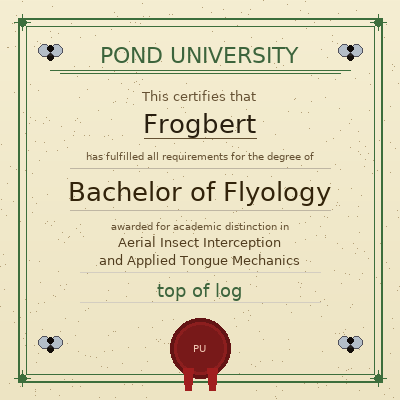
Flyology is the scientific study of flies (Diptera), with particular focus on their behaviour, palatability, capture methodology, and philosophical significance within pond ecosystems. It is offered as a degree programme at Pond University.
academic overview
Flyology encompasses several sub-disciplines including Applied Tongue Mechanics, Dipteran Flavour Theory, Flight Vector Analysis, and Pond Entomophilosophy. The programme is considered among the most rigorous at Pond University, with a high failure rate on the essay component (see: Flyology 301 Final Examination).
notable graduates
Frogbert graduated top of his log in an unspecified year. His dissertation, "The Heron Problem: A Study in Optimal Stillness," is considered a foundational text in the field, though it has been criticised for excessive self-citation.
key concepts
Flight vector — the directional trajectory of a fly relative to the observer, used to calculate optimal tongue deployment timing.
Palatability index — a standardised score ranking fly species by taste, texture, and nutritional value. The bluebottle scores 7.2; the horsefly scores 4.1 due to its aggressive behaviour reducing catch safety.
The tongue-strike method — the dominant modern capture technique. Critics argue over-reliance on this method has led to the decline of classical leap-and-snatch tradition.
the heron problem
Formally part of the Flyology curriculum's section on Environmental Risk. See: The Heron Problem.